Incompatible Devices - Emergency Calling (000) Update - more info here.

NBN 100: HOW DOES IT STACK UP?

Are you on the right nbn plan? Let’s check.

Is nbn 100 still enough for your household?

nbn 100 has long been the “we’re doing fine”, generally recommended plan for Aussie share houses and family homes of 4+. But that was before every single person had a phone, a laptop, a smart TV, a console and approximately 47 other devices fighting for Wi-Fi at 8pm. If your Netflix drops to pixel soup the second someone starts a download, that’s your sign.

If you’re on FTTP or HFC, nbn 500 is the glow-up. It’s 5× faster than nbn 100 and not wildly more expensive. Which means fewer loading screens, less group chat rage and way more bandwidth for your nightly scroll/stream/game marathon. Same chaos at home — just with less buffering.

What is an nbn 100 plan?

It’s a strong step up from entry-level plans. And if you’re rocking with a FTTC or FTTN connection type, the 100 Mbps plan may be the fastest plan you’re eligible for. That’s why, historically, it was a solid choice. For those on an FTTP or HFC connection types, the nbn 100/20 plan has been automatically upgraded to 500 Mbps by the nbn since September 2025. That means with the right provider, you can have 5x the speed for a great price!

If you’re on 100/40, here’s the awkward bit

When 100/20 scored that free speed bump in September 2025, 100/40 missed out. So, if you’re paying for it, you’re not exactly getting a win. Consider this your sign to step it up properly — 500/50 delivers a serious download increase and faster upload speeds for WFH, gaming and streaming.


What can you do with an nbn 100 plan?

An nbn 100 connection is great for*:

  • 4K streaming on 1-4 devices

  • Consistent video calls when working from home 
or studying

  • Online and cloud gaming

  • Support for a few connected devices at the same time

* Real world results may vary based on the nbn tech installed at your home and the devices you use.  

nbn 100 vs nbn 500: worth the upgrade?

Like we said above, if your household internet is starting to feel a bit crowded, you may want to think about an upgrade. nbn 500 is the next logical step up to meet your household’s internet speeds.

With five times the speed, nbn 500 gives every device room to breathe and the price? Pretty much the same.

nbn 100 vs nbn 500? 

What can you do with your plan? 
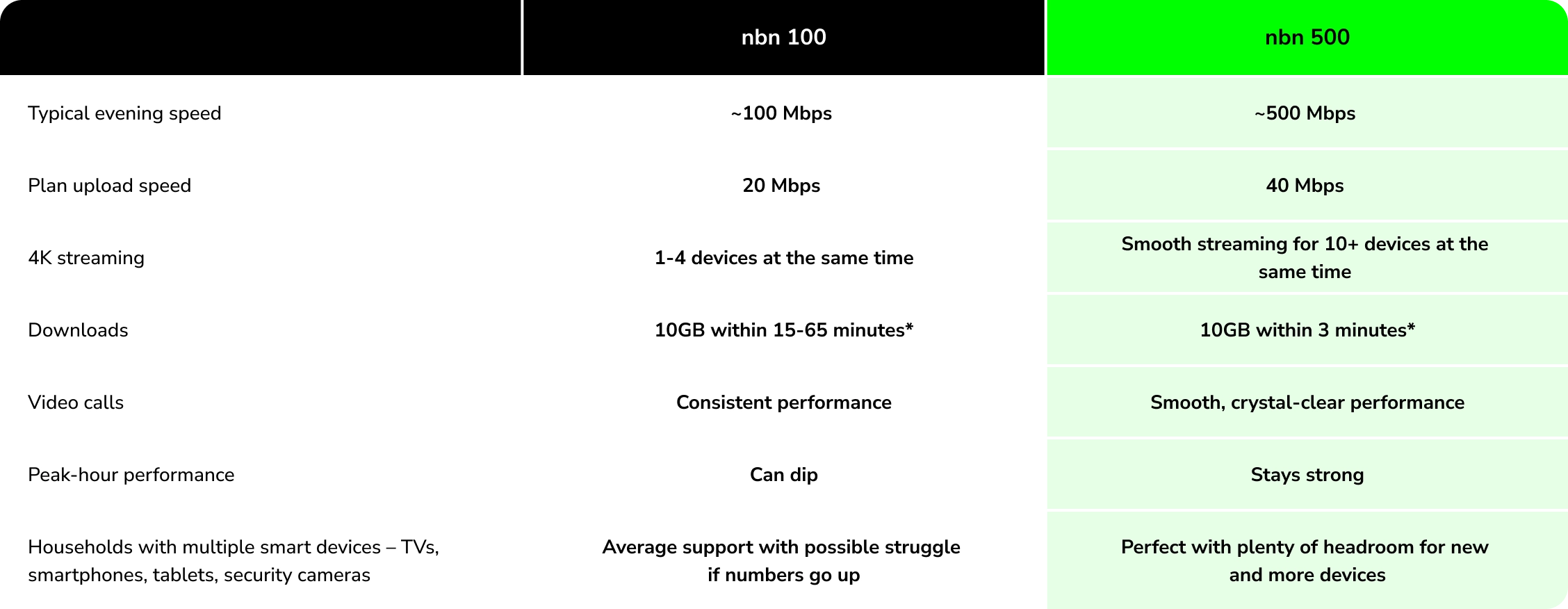
* Real-world results may vary with Wi-Fi, router quality, home setup and server speeds.

According to Canstar’s research1, Aussies are forking out around $85 a month for internet on average. Meanwhile, Exetel’s One plan is serving up nbn 500 speeds (TES: 500/40 Mbps) for $80 a month ongoing — no “surprise, promo’s over” plot twist a few months in. Faster than what most people are on, cheaper than the national average and none of that gotcha energy? The decision basically makes itself. Easy. The One.

Why choose nbn 500 over nbn 100

Like we’ve already yelled from the Wi-Fi rooftops, choosing nbn 500 (ahem, The One Plan) is kind of a no-brainer. And if you’re already on FTTP or HFC and cruising along on nbn 100? The switch is easy.

Faster, better, stronger

Downloads absolutely send it. Uploads don’t limp across the finish line. Your streaming stays HD, your gaming doesn’t rage-quit, and your video calls stop freezing on your worst possible facial expression.

Built for busy homes

Everyone online at once? Go off. One person’s in a work meeting, someone else is deep into Netflix, another’s mid-game — and the 
Wi-Fi isn’t having a meltdown 
about it.

Elite value if you’re fibre-ready

If you’re on FTTP or HFC, nbn 500 unlocks seriously quick download and upload speeds without tipping into expensive business-plan territory. Big speed energy, normal-person price tag.

Turn that upgrade into a long-term win

And if you’re thinking “sure, but do we really need that much speed?” — let’s hit you with the receipts. Aussie households are now downloading around 508GB2 every single month — up 10% in a year and literally double what we were using back in 2019. Uploads are climbing even faster, up 12% year-on-year. We’re not just doom-scrolling harder; we’re streaming in 4K, backing up entire camera rolls and running homes that are basically powered by Wi-Fi. Translation? Our internet habits have evolved. nbn 500 isn’t extra. It’s just keeping pace.

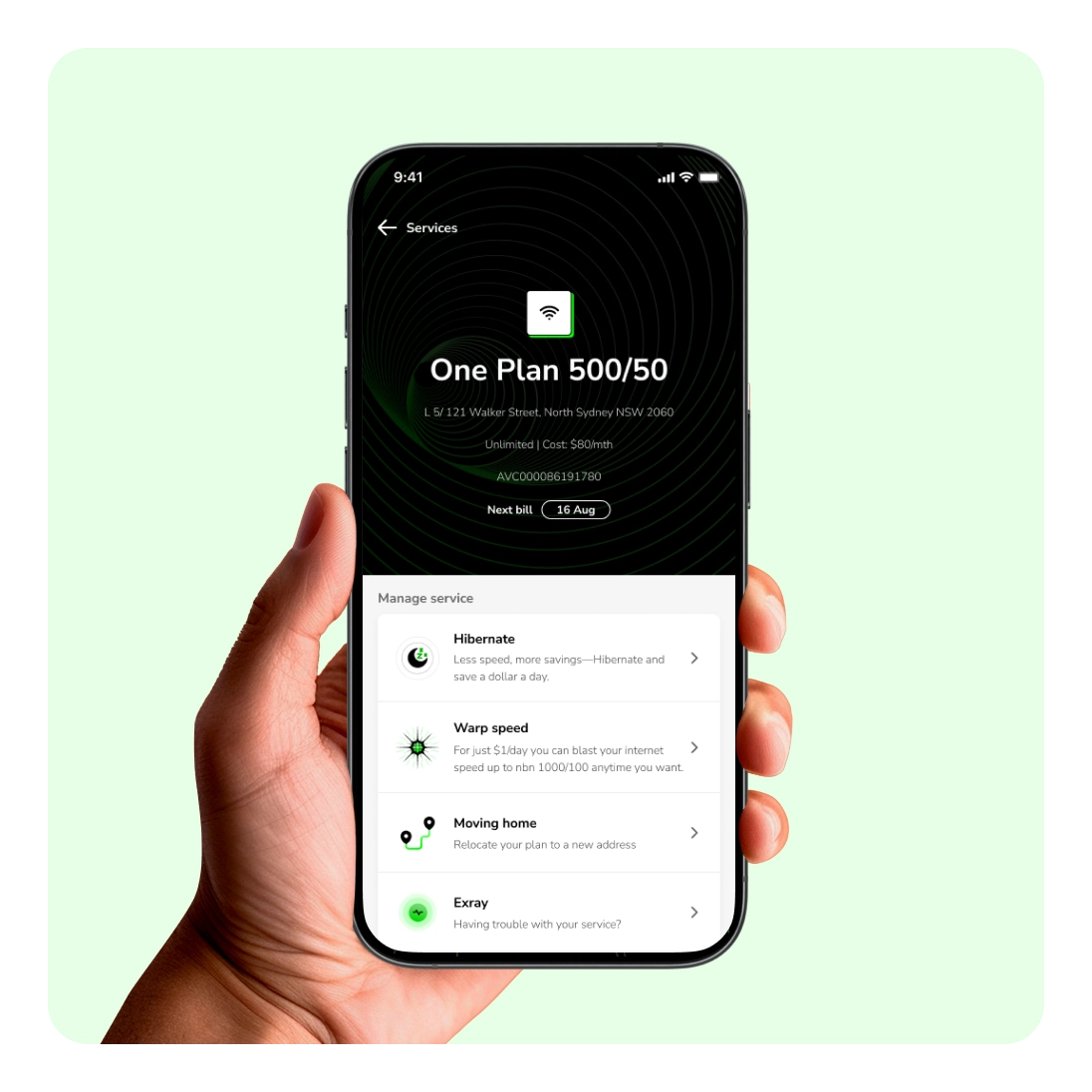
Which is exactly where Exetel's One Plan comes in

Powered by nbn 500 (TES: 500/40 Mbps), it’s made for households that are done playing the “should we upgrade again?” game every 12 months. It’s just smooth, reliable, no-drama internet that keeps up with your current chaos — and whatever new devices or streaming obsessions you add next. Fast now and not sweating the future.

Fibre: upgrade from nbn 100 to nbn 500

If you’re on FTTN or FTTC, you may be eligible for a free* upgrade to FTTP (Fibre to the premises). Once you’ve upgraded to fibre, sticking with an nbn 100 plan means missing out on what fibre is really capable of while pretty much paying the same price.

*Free standard fibre upgrade only. See T&Cs for more information. 

More reliable, consistent speeds

Fibre delivers a stronger, more stable connection that isn’t affected by distance, weather, or peak-time congestion. That means fewer dropouts, smoother performance, and an internet connection you can rely on day and night.

Access to ultra-fast plans like nbn 500

Fibre unlocks access to the fastest internet plans available today, including nbn 500 and beyond. Enjoy lightning-fast downloads, rapid uploads, and the ability to handle multiple devices at once.

Better performance for work, play, and streaming

Whether you’re working from home, video conferencing, gaming online, or streaming in 4K, fibre provides low latency and consistent speeds. Everyone in the household can be online at the same time with minimal interruptions.

Internet that’s ready for 
the future

Fibre is built to support tomorrow’s technology. As smart homes, cloud services, and higher-speed plans become the norm, fibre ensures your home is ready—no further upgrades needed.

nbn 100 vs nbn 500

Find the answers to frequently asked questions here

nbn 100 feels fine most of the time. Why would I change?

“Fine most of the time” is doing a lot of work in that sentence. You’ve already made the decision that fast internet matters. The question is whether you’re one step short of where that decision pays off. nbn 100 handles today’s household reasonably well. The problem is that the household keeps growing. The average household now has 25 devices and will hit 44 by 20303, most of which are doing background activity. Most people add new devices to their Wi-Fi network without any thought to the ceiling nbn 100 provides. nbn 100 is good at the quiet moments, however nbn 500 is what would stop your internet connection becoming your household’s daily point of friction. The upgrade isn’t about peak performance on a speed test. It’s about removing trade-offs from your connection.  

Do I actually have 25 devices? That seems like a lot.

Let's count them. A couple of phones. Work laptops. Personal computer. A tablet. A Smart TV. An apple TV. A gaming console. Smart speakers. Robot vacuum. Security cameras. Video doorbells. Smart lights. A Wi-Fi printer. Smart plug and switches. Temperature & Humidity sensor. Smart fans. None of these feel heavy on their own but each of them are doing something at all times. Syncing, updating, backups. On nbn 100, that background hum starts to compete with what you may be actively trying to do. On nbn 500, it genuinely stays in the background.  

I’ve been on nbn 100 for years now and it’s been fine. What’s actually changed?

When you first got nbn 100, it was genuinely the best mid-tier plan available which was perfectly positioned for most households. Streaming was still ramping up. Smart home devices were niche. Cloud storage was something people used occasionally, not constantly. Work from home was not a baseline. All this meant that the ceiling for your broadband connection felt distant.  

Now? Every phone backs up photo libraries automatically. Every laptop syncs files to the cloud. Security cameras upload footage 24/7. Smart speakers listen and respond. Firmware and security updates for devices download in the background on everything from your TV to your fridge. Work calls compete with kid’s online classes or multiplayer gaming lobbies. 4K streams that used to be occasional are now default. nbn 100 hasn’t gotten slower but the demands on it have quietly grown device by device, app by app, until the margin your connection once had is gone. The connection that felt spacious a couple of years ago is now running near capacity on an average evening not because you’re doing anything differently, but because everything you own is doing more, all the time.  

nbn 500 isn’t about chasing speed, but about rebuilding the margin you used to have. The buffer that made the internet something you didn’t have to think about. That’s what has changed.   

We’re empty nesters. Don’t have kids. Isn’t nbn 500 meant for bigger families?

That’s an older way of thinking about internet plans that doesn’t hold true anymore. The “household size” heuristic assumes people are the main users of bandwidth. They’re not. Devices are.  

A two-person household in 2026 in still running smart home systems, multiple streaming subscriptions, cloud storage syncs across devices, work from home setups with default settings of background updates on everything. The internet load isn’t about how many people live there. It’s about how many things are connected and what these devices are doing simultaneously. If anything, smaller households often have more discretionary spend for connected devices per person. On nbn 100, the ceiling is close enough that a busy evening pushes against it. With nbn 500, you’re unlikely to find it.  

A two-people modern home is exactly the profile that benefits from the higher ceiling that nbn 500 provides. The question is not about household size anymore. It’s whether you want the connection to keep up with how you actually live and stay connected.  

I’m renting and my landlord or strata don’t want to go through the hassle of upgrading to fibre. How can I get nbn fibre?

A lot of people on FTTN/FTTC connections have settled to accept the idea that 100 Mbps is as good as it gets, not because they don’t want better, but because the perceived hassle of upgrading the infrastructure feels insurmountable. Here’s what has changed: nbn’s Fibre Upgrade program is now significantly streamlined. In many cases, the install is non-invasive and doesn’t require major building work. For rentals, landlords are increasingly seeing fibre as a value add that makes properties easier to rent and worth more. Strata approvals have also become more routine as fibre becomes standard infrastructure for the building rather than a special request. 

It’s also important to be clear about the process. While tenants can absolutely request and initiate an upgrade, you do need written permission from your landlord or property manager before proceeding. The installation can involve drilling and, in some cases, minor digging to install new equipment, so you cannot move forward without their approval. The good news is that you can approach this as a benefit rather than a burden — fibre typically adds value to the property, improves its rental appeal, and standard installation under the upgrade program is generally free*.

Unlocking access to fibre allows you to move to higher-speed internet that is more reliable and often costs the same or less than what you’re likely paying now. The downside of not advocating for the upgrade is staying stuck on a connection that was always meant to be temporary. 

*Free standard fibre upgrade only. See T&Cs for more information. 

How will upgrading to FTTP improve my connection?

Fast is good. Fast and reliable is better. Upgrading to FTTP isn’t just about going faster. It’s about getting more consistent performance and upgrading the foundation of your connection.  

Besides access to faster speeds, FTTP is much more predictable and stable day to day as compared to older copper-based access technologies (FTTN / FTTC) which tend to experience small, repeated interruptions. This is because copper connections are more sensitive to weather, line interference over distance and line degradation over time. By replacing the copper last mile with fibre, FTTP connections are designed to reduce repeated daily interruptions, provide more predictable performance and support higher capacity without line quality degrading over time.  

ACCC Measuring Broadband performance report4 highlights measurable difference between fibre and copper-based technologies for outage frequency and outage duration. ACCC data shows FTTP connections have reduced levels of frequent, recurring dropouts compared to copper-based services. This translates to a more stable experience particularly in busy, smart households where every dropout is felt.  

The One plan

Exetel’s one-and-only nbn plan keeps things simple but speedy, offering 500 Mbps (TES: 500/40 Mbps) downloads during peak hours for gamers, streamers, working from home and all your connected devices 
all at once.

Related articles

Why Exetel’s The One plan is a no-brainer

Been shopping for an internet plan right for you? Well, the search is over.

Should I upgrade to Fibre to the Premises (FTTP)?

Upgrade to nbn fibre (FTTP) with Exetel One Plan for lightning-fast speeds, reliable connections, and future-proofed connectivity.

What is a good internet speed for home use in Australia?

Understanding internet speeds and which one is right for your home.

How this Exetel internet customer bill dropped to just $3/mth

Yici joined Exetel’s The One plan in July 2025 and hasn’t looked back. 77 referrals later, those $1-a-pop discounts have stacked up to some serious savings.

© Copyright 2026 Exetel Pty Ltd. All rights reserved.